Shoreline Protection on Lake Simcoe and Lake Couchiching
Lake Simcoe and Lake Couchiching are inside our service area, which includes Barrie, Innisfil, Orillia and Ramara. Shorelines here deal with ice break-up, wind-driven waves and a lake whose level is managed by Parks Canada. This page covers what the shoreline faces, who approves the work and how a revetment is built. We supply and install shoreline stone across our service area.
What Lake Simcoe does to a shoreline
The Lake Simcoe Region Conservation Authority, known as LSRCA, names the break-up of the ice sheet in spring 2018, with storm surge and seiche, as the most recent significant shoreline damage event on the lake. It damaged the eastern shoreline. Parks Canada also lists freshet ice among the factors in spring flooding on Lake Simcoe and Lake Couchiching.
Wind exposure matters as well. LSRCA describes a high shoreline risk status as a risk of damage to docks, boathouses and shoreline on the shores exposed to the prevailing winds.
The lake level is managed. Parks Canada operates it through the Trent-Severn Waterway, using a target curve that has been in use since 1918. LSRCA reports a recorded high of 219.5 metres and a recorded low of 218.4 metres, with a typical annual change of about 0.4 to 0.5 metres. In years of high runoff the lake can rise above its target curve, and LSRCA says local flooding is mostly in the lower part of Cook's Bay. Parks Canada publishes current and recent water levels on an interactive map, updated daily from readings taken at about 6 a.m.
Who approves shoreline work here
Lake Simcoe Region Conservation Authority
LSRCA administers Ontario Regulation 41/24 within the Lake Simcoe watershed. Work near a lake, river, stream, steep slope or wetland may need its approval. Its permit decisions must also conform to the designated policies of the Lake Simcoe Protection Plan.
The plan's shoreline policies bar significant alteration of the shore unless it stabilizes, protects, restores or rehabilitates the shore. They also say that shore alteration for stabilization or erosion control is to use natural treatments, such as planting and bioengineering, where practical, with a vegetated riparian area where feasible.
The Lake Simcoe Protection Plan also sets a vegetation protection zone along the shore of at least 30 metres in built-up areas and 100 metres outside settlement and built-up areas, and it allows structures in that zone only where there is no alternative and the effects are minimized. LSRCA offers an Interactive Regulation Mapviewer for checking whether a property is in its regulated area. Applications are made on its online permit application form.
The authority for a property on Lake Couchiching depends on where it sits, so confirm which authority covers the lot.
Under the Conservation Authorities Act, LSRCA and the Nottawasaga Valley Conservation Authority, with Grey Sauble, Ausable Bayfield, Maitland Valley and Saugeen Valley, amalgamate into the Lake Huron Regional Conservation Authority on the transition date, February 1, 2027, or a later date set by regulation. Check which authority covers your lot at the time you apply.
Parks Canada
Lake Simcoe and Lake Couchiching are on the Trent-Severn route. Parks Canada requires a permit for work on, under or over the bed and waters of the waterway, including shoreline stabilization. The online application asks for a detailed plan, the deed, the survey plan and a summer photograph, states no fixed processing time and asks owners to apply several months ahead. Ontario's work permit page excludes portions of the Trent-Severn from the ministry's shore lands, so ask which permit applies at your address.
Municipalities
Innisfil requires a community planning permit on Lake Simcoe frontage that covers site work such as grading, fill, vegetation removal and shoreline work. Barrie's Site Alteration By-law regulates fill, topsoil removal and changes of grade. Ramara requires a fill permit before work begins. Check the by-laws of your own municipality.
Fisheries and Oceans Canada
Fish habitat is protected under the federal Fisheries Act. In-water work has to avoid the spawning periods that the Ministry of Natural Resources sets by species and region, and the permit conditions confirm the window for a given lot.
The full picture is in Shoreline permits in Ontario: who approves what.
What a Lake Simcoe Region Conservation Authority permit costs
The authority sets its own permit fees. Under its Planning and Development Fees Policy 2026, approved by its Board on March 6, 2026 and effective April 1, 2026 for a two-year period unless the Board updates it earlier, the fees for a permit application under the Conservation Authorities Act on private residential property are:
- Routine permit application, limited review and minor in nature: $624.
- Minor permit application, low risk, no technical reports, small scale: $780.
- Intermediate permit application, moderate risk, detailed plans or reports required: $2,013. The authority's fee schedule gives shoreline bioengineering and replacement structures as examples in this category.
- Major permit application, high risk, technical studies required: $6,018.
- Retroactive permit, for work done without a permit: 25 percent of the original fee, up to three times the fee with non-compliance.
The authority decides which category a project falls into. Larger or higher-risk shoreline work may need technical studies, and those are at the owner's cost. These are the authority's fees, not ours, and they are separate from the cost of the shoreline work itself.
The authority reviews its fees annually, and it is part of the February 2027 consolidation described above, so confirm the current fees when you apply.
How a revetment is built on a lake like this
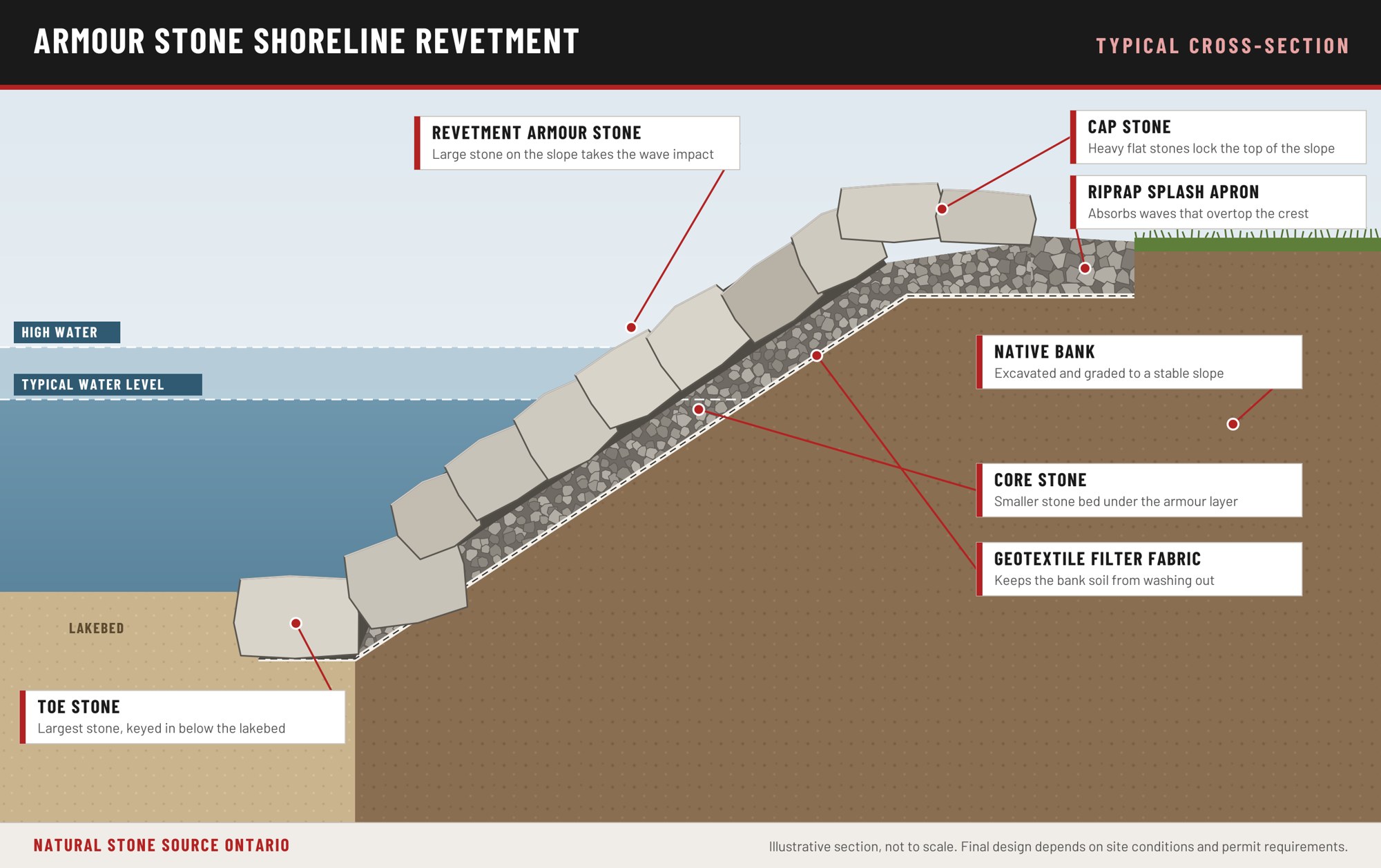
The sequence is the same on every lake. Toe stone goes in first, below the lakebed. Core stone and filter fabric follow, then the armour layer, then cap stone. On Lake Simcoe the design also has to address the planting and the vegetated buffer behind the stone where the Protection Plan applies.
What shoreline work costs
Shoreline work typically runs from about $500 to $20,000 per linear foot, depending on the scope of work, the height of the bank, the size of the lake and the wave exposure the site takes. Permit fees are extra. Every project is quoted after a site visit.
Questions about Lake Simcoe shorelines
Does Parks Canada or the conservation authority approve shoreline work on Lake Simcoe?
Potentially both, and the municipality as well. The Lake Simcoe Region Conservation Authority administers the conservation authority regulation in its area. Parks Canada requires a permit for in-water and shoreline work on the Trent-Severn Waterway and manages the lake's water level. Ask each about your property.
Can stone be used on a Lake Simcoe shoreline?
The Lake Simcoe Protection Plan does not state a blanket ban on shoreline hardening. It restricts significant alteration of the shore and calls for natural treatments where practical. Whether stone is appropriate on a particular lot is a decision for the conservation authority and the other approving bodies.
How much does the lake level change?
The Lake Simcoe Region Conservation Authority reports a typical annual change of about 0.4 to 0.5 metres, within a recorded range of about 1.1 metres between the historic low and high. Parks Canada manages the level against a target curve.
Which towns do you serve on these lakes?
Our service area includes Barrie, Innisfil, Orillia and Ramara. Send us the township when you contact us.
Planning shoreline work? Call 1-855-787-8663 or Request a Quote.
What to send us: photos of the shoreline, the approximate length in feet, the lake and the township.